
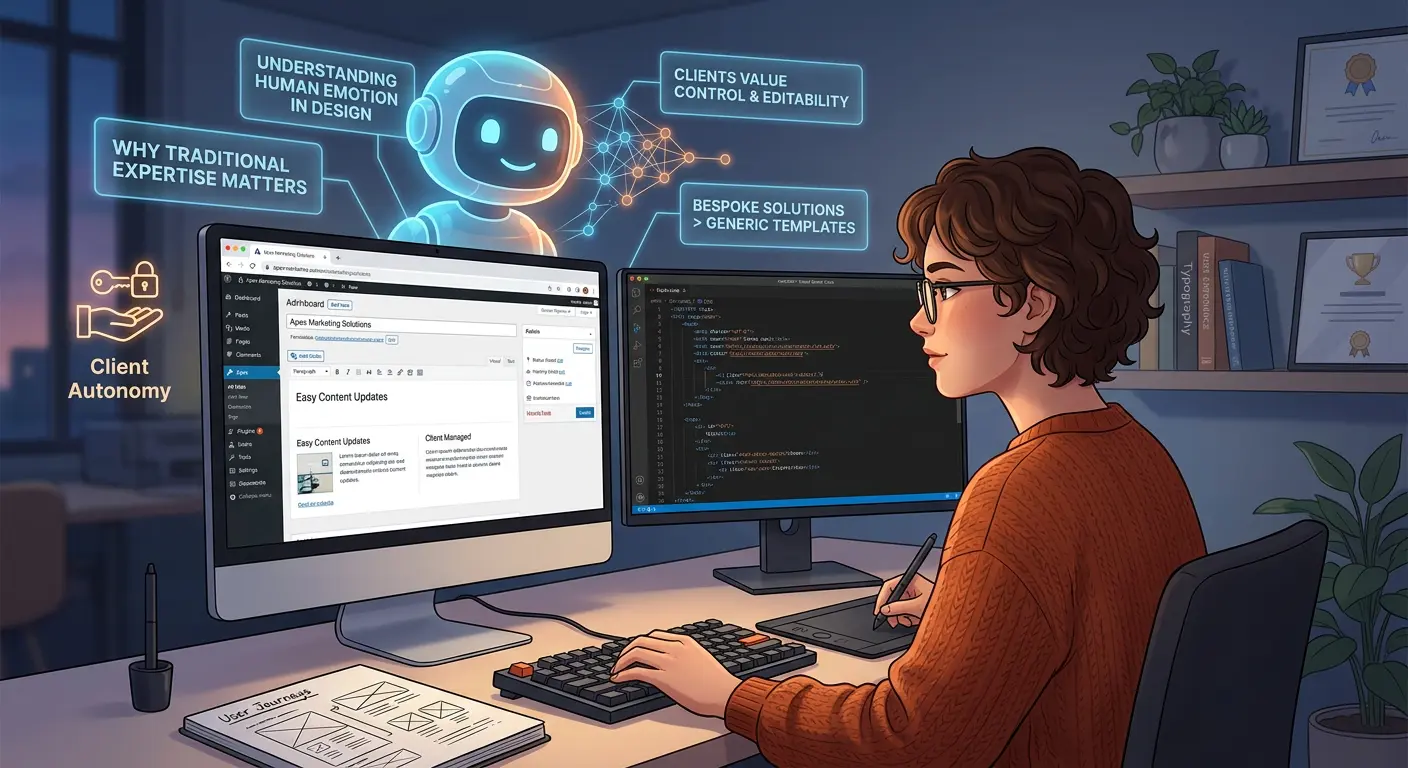
The narrative surrounding artificial intelligence in digital production is usually framed in extremes: automation is coming, traditional craft is obsolete, and building a professional website will soon require nothing more than a descriptive prompt typed into a chat window. Honestly, it’s pretty easy to see how this perception has taken root; generative AI tools can now draft mockups in seconds, produce snippets of HTML and CSS, and write basic PHP scripts with impressive accuracy. To an outsider, website creation looks like a simple mechanical process of writing code and assembling visual layouts; tasks perfectly suited for machine learning models.
Anyone working in the web industry however, or any business owner who has managed a live digital presence, knows this fundamental truth: A website is not a static artifact. When your website goes “live” that’s not the end of the job; it’s just the beginning! Your website is a dynamic, living operation just like your business or organization. While AI is undeniably reshaping workflows and speeding up routine production, it cannot replace the traditional disciplines of web design, custom engineering, and ongoing maintenance. Above all, AI struggles with the most critical aspect of modern web operations: enabling non-technical clients to comfortably, predictably, and continuously manage their own content.
1. The Gap Between Pretty Mockups and Real-World User Experience
We’ve had a phrase here at 43Folders since we started the business: “Pretty is easy.” In a post-Squarespace/Wix era, this is even more true, as generative AI excels at superficial creation. Prompt an AI tool to produce a website layout for a boutique law firm or a modern SaaS startup, and it will return a visually pleasant image or code skeleton in no time. But visual aesthetics are only a fraction of what makes a website successful.
Traditional web design is fundamentally an exercise in strategy, human empathy, and business goal alignment. It answers complex structural questions:
-
How do diverse user personas navigate information and use your website?
-
How does the visual hierarchy lead a user toward a meaningful decision?
-
How do brand identity, tone, and interactive feedback work together to build trust?
AI models generate layouts based on statistical averages of existing web pages. Consequently, they tend to produce generic designs that look like everything else on the internet. They lack genuine context and understanding of your business or organizational needs and goals. An AI cannot interview stakeholders, uncover hidden organizational goals, synthesize qualitative user feedback, or make intentional, creative sacrifices that break conventions to highlight a unique brand narrative.
Furthermore, real-world design involves strict standards for accessibility (WCAG compliance), responsive performance across hundreds of device configurations, and user experience (UX) architecture. Translating brand identity into a resilient design system requires human oversight, strategic reasoning, and creative judgment that algorithms simply imitate rather than understand.
2. The Content Management Reality: Why Platforms Like WordPress Remain Indispensable
The biggest flaw in the “AI will build your site” promise often emerges in the days and weeks after your site goes live. A site built purely out of AI-generated code or rigid page templates can be a nightmare to update, and what may seem like a simple, easy change ends up requiring hours of time in prompting and tweaking to ensure you aren’t starting from square one each and every time.
In the real world, we’ve found that our clients don’t want to prompt an AI every time they need to fix a typo, update product pricing, add an event to an editorial calendar, or publish a press release any more than they want to contact us for those things. They need an intuitive, reliable Content Management System (CMS) and an understanding of how to use it, much like you use PowerPoint to update your sales presentation.
This is why platforms like WordPress combined with power tools like Divi, WPBakery, Elementor and other visual page builders continue to drive a massive portion of the web. WordPress and similar platforms aren’t just code engines; they are human interface systems designed to bridge the gap between complex software architecture and everyday non-technical users.
The Client’s Need for Autonomy and Guardrails
When we construct a bespoke WordPress platform, we aren’t just writing code for a browser, we’re building an authoring environment tailored to a client’s daily workflows.
-
Structured Content and Custom Fields: Custom Gutenberg blocks, Advanced Custom Fields (ACF) post and page data, tailored post types, external API and other coding requirements can be built in directly and leverage the easy editing capabilities of WordPress. This ensures a marketing or other team member can log in, add content, upload an image, and make simple changes knowing the system will format it perfectly across desktop, tablet, and mobile displays without breaking anything requiring a rebuild.
-
Editing Safety: If a client edits raw AI-generated HTML/CSS or works inside an unconstrained visual builder, misplaced tags or oversized images can shatter page layouts, destroy mobile responsiveness, ruin site performance, and blow up your SEO. Traditional development establishes intentional guardrails that empower clients to manage content freely without breaking the site.
- Enhanced Security: Adding AI-generated code you didn’t create and may not understand can lead to enormous security issues that can lead to your site being taken down by hackers, or worse – like having customers and other visitors exposed to malware and losing faith in your business.
-
Workflow and Governance: Real organizations require editorial workflows that include roles, permissions, draft revisions, scheduled publishing, and content staging environments. These operational features are integral parts of traditional web architecture, far removed from the capabilities of standalone code-generation algorithms.
AI produces static files but does not intrinsically understand human-centric admin design. Building a back-end dashboard that feels effortless for a non-technical marketing director requires human developers who understand user workflows and administrative usability.
3. Custom Logic, Complex Integrations, and Edge Cases
Most websites rely on far more than “brochureware” type front-end styling. Modern business websites function as central hubs in complex software and marketing ecosystems, connecting to CRMs like Salesforce or Hubspot, custom payment gateways, ERP systems, third-party APIs, and proprietary client databases. While AI coding assistants are helpful for writing routine functions or debugging syntax, they struggle with more complex system architecture, edge-case handling, and contextual problem-solving.
-
Architectural Integrity: Writing isolated functions is easy; building a scalable, secure software architecture that handles thousands of concurrent requests while communicating with legacy databases is hard. Human developers design systems with security, performance, and future scalability in mind.
-
Contextual Troubleshooting: When an API update breaks a payment gateway, or a database query causes server timeouts during a traffic spike, AI cannot reason through the specific environment, server configs, and legacy codebase quirks to solve the problem reliably.
-
Business Logic: Business rules are rarely linear or standard. A custom shipping calculator, a complex subscription rule set, or a multi-tiered membership portal demands custom logic built precisely around an organization’s unique operating model.
Traditional development treats code as a structured product that must be maintained, refactored, and evolved. AI code generation, if unguided by senior developers, can result in brittle, unmaintainable “spaghetti code” that creates debt and security vulnerabilities down the line.
4. Maintenance, Security, and Strategic Evolution
Launching a website is not the finish line; it is the starting point. Digital environments are constantly shifting; web browsers update, standards change, security threats evolve, and server environments require upgrades to their operating systems, PHP, and databases.
Maintaining a website requires continuous stewardship:
-
Security Patches and Updates: Open-source platforms like WordPress thrive because of active communities that continuously issue core, plugin, and theme updates. Evaluating compatibility before running updates, auditing third-party code, and managing patches without causing downtime require human technical expertise.
-
Performance Optimization: Site speed is critical for SEO and conversion rates. Optimizing database queries, managing asset delivery, configuring server caching, and refining render paths require deep technical analysis, not just automated quick fixes.
-
Strategic Adaptation: A company’s website must pivot as the business grows. Expanding into new markets, launching fresh product lines, or re-evaluating conversion funnels require strategic workshops, continuous A/B testing, and ongoing iterative development.
An AI model cannot proactively monitor server health, audit security logs, or sit down with a client to align their web roadmap with quarterly business targets.
The Future: AI as Co-Pilot, Not the Pilot
The argument here is not that AI has no place in web design and development. On the contrary, we see AI as an indispensable tool for our processes. We’re using AI to help with boilerplate code, generate regex patterns, automating repetitive tasks, and inspiring new ideas. Our designers are using AI to generate mood boards and streamline asset creation. Content creating is faster than ever now, with AI able to brainstorm outline structures and refine copy.
Believing that because AI is so good as an efficiency multiplier means it can be used as a replacement for human expertise is a huge mistake. The heart of web design, development, and maintenance has never been merely outputting code – it has always been about communication, customer relationships, usability, and strategy. As long as human beings are the ones using your website to engage with your company or organization, the demand for human expertise to build and maintain those environments will remain steadfast.
0 Comments